

Vending machines and self-service kiosks are both designed to reduce manual service and allow customers to complete transactions independently. However, they serve different purposes.
The simplest difference is this: a vending machine normally sells and dispenses a physical product directly, while a kiosk helps customers order, pay, check out, register, or access a service through an interactive interface.
What Is a Vending Machine?
A vending machine is an automated machine that stores physical products inside the unit.
Customers normally:
● Select a product
● Make a payment
● Receive the product directly from the machine
Typical vending machine products include snacks, drinks, packaged food, personal care products, electronics accessories and other standardized goods.
Because products are physically stored inside the machine, vending machines require inventory compartments, dispensing mechanisms and regular restocking.
What Is a Self-Service Kiosk?
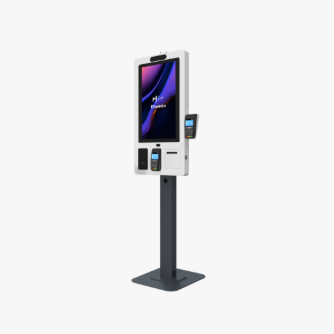
A self-service kiosk is an interactive terminal that allows customers to complete tasks without assistance from staff.
Depending on the application, customers can use a kiosk to:
● Browse products or menus
● Place an order
● Customize an order
● Make a payment
● Print a receipt or ticket
● Check in or register
● Complete self-checkout
● Join or manage a queue
Unlike a vending machine, the kiosk does not necessarily store or dispense the product itself. Instead, it usually connects with POS software, ordering systems, payment systems or other business platforms.
Vending Machine vs. Kiosk: Key Differences
| Comparison | Vending Machine | Self-Service Kiosk |
|---|---|---|
| Main purpose | Sell and dispense products | Ordering, payment and self-service |
| Physical product storage | Usually required | Usually not required |
| Product dispensing | Yes | Normally no |
| User interaction | Simple selection and payment | Interactive touchscreen workflow |
| Product customization | Limited | High |
| System integration | Usually simpler | POS, payment, ordering and management systems |
| Typical applications | Snacks, drinks, packaged goods | Restaurants, retail, hotels and public services |
The biggest difference is therefore not the touchscreen or payment method. Modern vending machines and kiosks can both support digital payments and connected software.
The key question is what happens after the customer completes the transaction.
If the machine automatically releases a stored product, it is generally a vending machine. If it sends an order, processes checkout, provides information or connects the customer with another business system, it is usually a self-service kiosk.
When Should You Choose a Vending Machine?
A vending machine is suitable when your business sells standardized physical products that can be stored inside the machine.
It works particularly well when:
● Customers need quick purchases
● Products require little customization
● The location needs unattended 24/7 sales
● Products can be easily stored and replenished
For example, beverages and packaged snacks are ideal vending machine products.
When Should You Choose a Self-Service Kiosk?
A self-service kiosk is a better option when the transaction requires more customer interaction.
Restaurants can use self-ordering kiosks to display menus, allow customers to select options and complete payment. Retail stores can use self-checkout kiosks to reduce checkout queues. Hotels and service locations can also use kiosks for check-in, registration or queue management.
For businesses that need flexible software integration and a larger interactive interface, kiosks generally provide more possibilities than traditional vending machines.
Elanda Self-Service Kiosk Solutions
Elanda provides self-service kiosk solutions designed for retail, food service, hospitality and public-service environments.
Available solutions include self-ordering kiosks, self-checkout kiosks and queue management terminals, with touchscreen sizes ranging from 21.5 inches to 32 inches. Different configurations can support ordering, payment and other self-service workflows.
For restaurants, retailers and system integrators looking to reduce waiting times and automate customer-facing processes, an interactive kiosk can provide a more flexible solution than a conventional vending machine.
Explore our Self-Service Kiosk range to find a suitable configuration for your application.
Conclusion
A vending machine and a kiosk may look similar, but their core functions are different.
Choose a vending machine when you need to automatically sell and dispense physical products. Choose a self-service kiosk when customers need to browse, order, pay, check out or access services through an interactive system.
For businesses that require customizable self-service workflows, POS integration and touchscreen interaction, a self-service kiosk is usually the more flexible choice.
